

 International
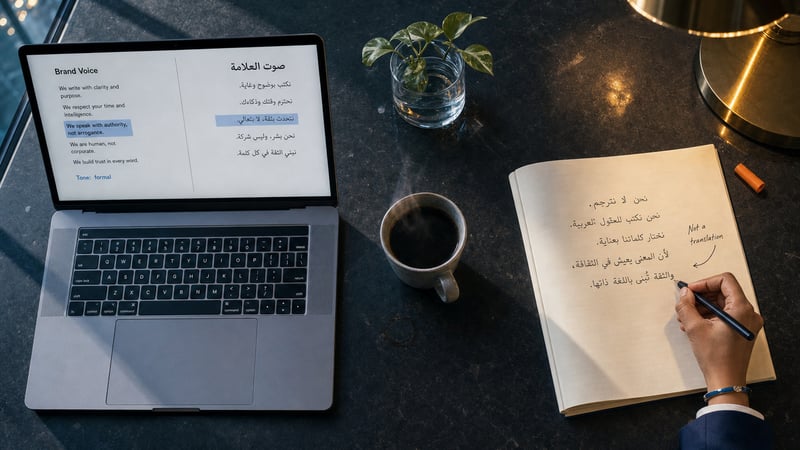

We would refuse to let any agent write Arabic until the Arabic voice has its own written guide, because a translated English guide produces literal, off-brand copy. AI brand voice documentation needs that separate Arabic guide. If your firm is about to let agents draft in both languages, and you are the partner asked to sign the result, the risk sits in the Arabic.
In our experience, most firms have half-documented their English voice and barely documented their Arabic. The agent writes Arabic as fluently as English, so the gap stays hidden until someone reads it closely. Without written rules, every Arabic draft is a guess. You either rewrite it by hand or approve copy you cannot judge, and it still goes out under your name.
What does an AI agent need to know about who we are and how we sound?
Your agent needs your brand identity and tone of voice written down first, because it can only reproduce a personality someone has described. OpenAI's prompt engineering guide structures a prompt as an identity, instructions and labelled examples. Identity and tone are inputs you supply. The model will not infer them.
Brand identity covers your positioning, target audience, value proposition and brand personality. A tax advisory firm serving family offices sounds different from one serving start-up founders, even when both explain the same rule. Give the agent neither audience and it writes for nobody in particular. Then your partners rewrite every draft.
Tone of voice says how you want to sound, such as professional, approachable or confident, and what you want to avoid. The "avoid" half does more work than firms expect. "Confident" with no limits drifts into the kind of sales claims a law or accounting firm would never sign. Write down what each word means in a real client email.
A clear personality still tells the agent nothing about which facts it may state.
Which claims and facts may the agent use?
Your agent should use only the claims on an approved messaging list: company facts, service descriptions, USPs, statistics, case studies and permitted claims. Microsoft's prompt engineering guidance puts instructions in the system message (the standing rules an agent reads before every request). That is where your claims rules and limits belong, kept apart from example material.
An agent without a list fills the gaps with whatever sounds plausible. For a professional services firm, an unapproved statistic under your name is a reputational problem before it is a marketing one.
Ask whoever owns your brand for one dated, signed-off list, with each claim marked as usable in English, Arabic or both. Include only case studies your clients have agreed to publish. If a claim is not on the list, the agent does not make it.
How do good and bad examples teach an agent our voice?
Approved Arabic and English samples, set beside examples of what to avoid, show your voice in a way written rules alone cannot. The OpenAI guide labels each example and keeps it separate from the instructions.
A rule says "approachable". A sample shows what approachable means in a client alert about a new tax rule. Avoid examples mark the edges: the over-familiar LinkedIn post, the stiff brochure, the copy that looks fine at a glance and says nothing. That last kind is how AI slop erodes trust in professional services firms.
Use pieces your partners have already approved, written natively in each language, and label each one "approved" or "avoid" with a line on why. An Arabic translation of an English piece is never your Arabic sample: it teaches the agent to translate.
One voice still sounds different in a LinkedIn post and in a proposal.
Do social, email, blog and sales copy need different rules?
Yes: channel guidelines set writing rules for social media, emails, blogs, website copy and sales materials, so one voice flexes without changing who is speaking. Each channel needs its own length, structure, formality and way of ending.
An agent with no channel rules writes everything as the same medium-length article. A partner's LinkedIn post, a client email and a proposal section have different jobs, and readers notice when they all sound alike. The firm starts to sound like a template.
Set the rules per channel and per language. Your Arabic social posts may run warmer than your Arabic proposals, and your English client emails may be shorter than your English blogs. Write down what you never do in each channel, such as emojis in client emails or hard selling in thought leadership.
Why does Arabic need its own writing rules?
MSA or dialect, formality, regional adaptation and a ban on literal translation are Arabic decisions your English guide never makes. An Arabic voice guide is a standalone document that sets the Arabic register, formality, regional choices and terminology, written for Arabic from the start.
We keep the Arabic and English guidelines apart for this reason, and the Arabic one carries a rule against literal translation. Running your English guide through a translation tool and calling the result your Arabic guide is the shortcut to refuse. An English phrase carried over word for word keeps its English order and idiom, so the Arabic reads stiffly and sounds like no one at the firm. The guide exists to stop exactly that.
Start with the register. For website content, we would default to Modern Standard Arabic, which is also the safer choice for content AI models need to understand and cite. Use dialect only where you choose it deliberately, such as social posts aimed at one market.
Then set formality: how you address a senior client, how direct the firm may be, which honorifics you use. Regional adaptation comes next, deciding where your copy should change for the market it addresses. The guide also names the terms you keep in English inside Arabic copy.
If agents at your firm will only draft English, and Arabic stays with a human writer, the Arabic guide can wait. Once an agent touches Arabic, it cannot.
Writing this guide is where doing it alone gets hard. Choosing the register, settling regional adaptation and then testing what the agent produces needs Arabic judgement and prompt engineering together.
That is the work of our AI consulting team: we configure agents around your documented voice, and prompt engineering is a core part of it.
English has choices to settle too, though fewer of them.
What belongs in the English guidelines?
Your English guidelines should settle UK or US spelling, terminology, sentence structure, tone and the expressions to avoid. Spelling is the quickest fix, and a proposal that mixes "organisation" and "organization" looks careless.
Sentence structure matters more than it sounds. Legal and advisory writing tends towards long, qualified sentences, and an agent will copy that habit from your old documents. Set a plain target, such as one point per sentence, if that is how you want to read to a busy client.
The list of expressions to avoid should be specific. Include the clichés partners strike out, the jargon your clients never use and the stock phrases agents reach for. A named list of banned words works better than an instruction to "avoid clichés".
Both guides will still name the same services differently unless one list governs the terms.
How do we keep both languages using the same terms?
Keep one bilingual terminology list of approved English-Arabic translations for services, technical terms, products and industry vocabulary, and give it to every agent. Without it, an agent may render "transfer pricing" three ways in three documents, and a client reading both versions wonders what you actually offer.
The list needs an owner who knows both Arabic and your technical field. Decide each term once: translate it, keep it in English, or use both on first mention. Add new services to the list before the agent writes about them, never after.
What goes into the knowledge base is a legal question as well as a brand one.
What may sit in the knowledge base in the UAE?
Client or patient material may enter your agent's knowledge base only with a documented basis under the PDPL, plus DHA or DoH rules for healthcare. The knowledge base is the set of documents an agent draws on when it writes.
The PDPL, Federal Decree-Law 45 of 2021, places duties on any UAE firm that handles personal data, and an AI agent's knowledge base is no exception. Old proposals and named case studies therefore need a recorded reason before they go in.
Healthcare firms carry a second layer. The DHA health information sharing policy covers every healthcare entity under DHA, and a patient story with only the name removed may still let a reader work out who the patient is. Abu Dhabi providers should check DoH rules the same way.
The decision you can make today: nothing with a client or patient name goes into the knowledge base until someone has documented why it may, a person reviews agent output before it goes out, and your approved messaging lists only material cleared for publication.
Which of the eight documents do we already have?
Answer these eight questions yes or no, once for Arabic and once for English, to see which documents exist, are current and cover both languages. Any "no" in the Arabic column is a reason to keep agents out of Arabic until it becomes a yes.
- Identity: Are your positioning, target audience, value proposition and brand personality written down?
- Tone: Does a tone of voice document say how you sound and what you avoid?
- Messaging: Is there a signed-off list of facts, service descriptions, USPs, statistics, case studies and permitted claims?
- Examples: Do you have labelled "approved" and "avoid" samples written natively in the language?
- Channel rules: Are there writing rules for social media, emails, blogs, website copy and sales materials?
- Arabic guidelines: Does a standalone Arabic voice guide set MSA or dialect, formality, regional adaptation, terminology and a ban on literal translation?
- English guidelines: Do your English guidelines settle UK or US spelling, terminology, sentence structure, tone and expressions to avoid?
- Terminology: Does one bilingual list hold approved English-Arabic translations for services, technical terms, products and industry vocabulary?
Most firms will find the English column half full and the Arabic column close to empty. Write the Arabic voice guide first. A translation can never stand in for it, and it is the gap your Arabic-speaking clients will spot before you do. Until it exists, let agents write English only.
Our AI team sets up agents and the prompts around them through our AI consulting work, starting from documents like these. If you want to talk through where your Arabic and English voice stand, book a free 15-minute call with our AI team.