
 International

When AI Overviews cite organic content without driving clicks, the right response is to defend search visibility for high-intent and category searches, make genuine expertise easy for AI systems to cite, and shift resources away from generic informational content that drives visibility without commercial impact. Pure SEO defence is now structurally incomplete, but abandoning it is too. The task is reallocation, not replacement.
For B2B and professional services firms, success should be measured through qualified pipeline, enquiries, branded demand and assisted influence. Rankings, AI citation share and organic traffic sit underneath those as diagnostic metrics. That reordering is the whole argument, and it changes what a marketing team optimises for.
Why traffic stopped being the objective
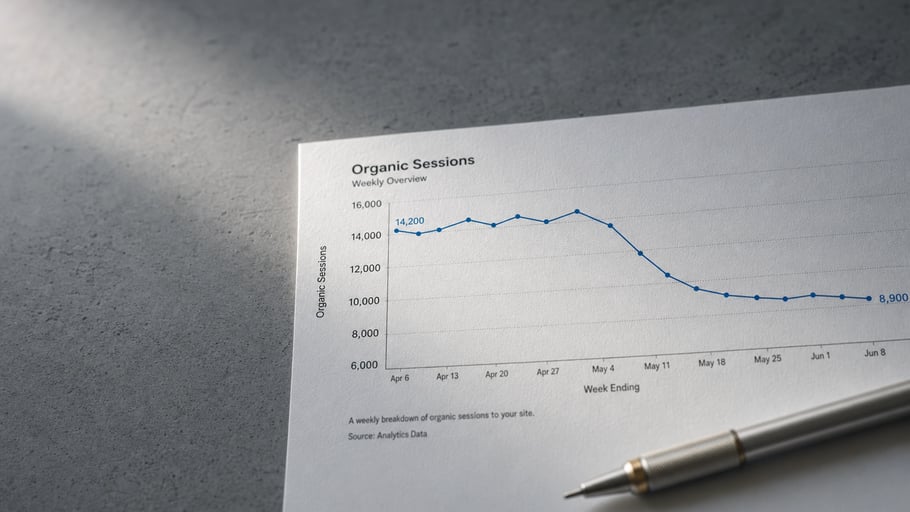
The behavioural shift is measurable. Organic click-through rate on informational queries featuring Google AI Overviews has fallen 61% since mid-2024, based on analysis of more than 3,000 queries. More revealing: even on queries without an AI Overview, organic CTR fell 41%. Users are clicking less everywhere. The click economy that SEO was built to feed is contracting regardless of whether an Overview appears on any given search.
This is why defending traffic as a headline number is a losing position. A large volume of low-intent informational visits can be worth considerably less than a small number of visits from people actively evaluating providers. Traffic itself was never the goal. It was a proxy for reach and, occasionally, for intent. AI Overviews have broken that proxy for informational content while leaving it largely intact for the searches that decide who gets considered. The same logic explains why publishing more content can mean less traffic.
Awareness and consideration are not equal
AI visibility does not automatically mean a brand is reaching warm leads. Someone exposed to a brand inside an AI answer may simply be researching a topic. That exposure can still matter, because they may remember the brand and return later, but visibility should not be confused with buying intent.
The value becomes far clearer when the query moves into evaluation. A buyer asking "which agencies can do this", "who are the leading companies for X", or comparing potential suppliers is behaving very differently from someone reading around a subject. Appearing in that answer carries real commercial weight. At that point, the buyer is far more likely to search the brand, visit the website, review credentials, look at case studies and make contact.
The data supports treating these as separate categories. G2's buyer research found AI chatbots had become the number one source influencing B2B vendor shortlists, and its 2026 survey found 82% of buyers had sourced software recommendations from an AI chatbot, with half saying AI mattered most when narrowing and comparing options. The shortlist is often built before a prospect ever reaches a company's pages, and people who do arrive from an evaluation query are more likely to be in a purchase mindset, which makes that traffic worth more per visit.
What to track for each stage
Generic informational visibility feeds future demand and belongs in an awareness bucket. High-intent visibility, where a buyer is comparing suppliers, belongs in a consideration bucket and should produce a more direct commercial outcome. Treating every citation as equally valuable hides the difference and misdirects budget.
The citation landscape is concentrating fast
A timing argument makes passive defence dangerous. AI answers name only a handful of providers, and Ahrefs found that the brands with the most web mentions earn up to ten times as many AI Overview mentions as the next group down. This is a winner-takes-all dynamic. Unlike traditional search, where a page-two ranking still earns some traffic, AI citation is closer to binary. A brand is either named in the answer or effectively invisible.
For firms in relationship-driven sectors, this changes the calculation. The window to establish category authority inside AI systems is narrowing, while most competitors still measure keyword rank. Much of that authority is brand equity built long before the question is asked. This concentration dynamic makes the reallocation framework below urgent rather than optional: once a small set of brands holds the majority of citations, moving resources later costs more and returns less.
How should B2B firms reallocate budget?
The reallocation is a set of decisions, not a single switch. Defend the searches where high commercial intent and clear buying signals already exist. Invest in making the strongest expertise citable, structured and specific enough that AI systems reach for it when a buyer asks an evaluation question. Reduce spend on broad informational content that ranks and gets cited but never touches pipeline. Most of that citable structure is ordinary SEO discipline, which is why AEO rarely needs a separate workstream.
| Content type | Buyer stage | Decision |
|---|---|---|
| High-intent and category searches | Consideration | Defend and strengthen |
| Supplier comparison and "who does X" queries | Consideration | Prioritise for AI citation |
| Deep expertise and case evidence | Consideration | Make structured and citable |
| Generic informational content | Awareness | Reduce if no commercial impact |
| Demand generation and branded reach | Awareness to consideration | Fund in parallel, not instead |
Demand generation runs alongside this, not after it. If the shortlist is forming inside AI answers, brand familiarity determines whether a firm is recalled and named at all. That familiarity comes from consistent demand-gen activity, not from a single piece of content. The parallel structure is the point: capture at the bottom of the funnel, build branded demand above it, and let organic visibility diagnose whether both are working. In practice, that means one plan across SEO, AI search, and demand generation, which is how Oxygen's digital marketing team works with UAE firms.
The measurement recalibration
Measurement has to move with the strategy. The load-bearing metric becomes share of citation, tracked across ChatGPT, Perplexity and Google AI Overviews on a defined query set tied to how the buying committee actually researches, and read alongside how the brand is described, because a visibility score can hide negative framing. That sits alongside brand search lift, direct traffic to high-intent pages, and incrementality testing on demand-gen programmes. Keyword rank should stop being a top-line KPI for informational queries, because it no longer correlates with visibility on the surfaces buyers use. Underneath it all, the primary measures remain qualified enquiries, pipeline, and assisted influence. The question worth asking is whether the brand is present at the moments that influence who gets considered and selected.
The timing of any investment matters as much as its direction. Oxygen's view on when B2B companies should invest in AI search visibility sets out the readiness conditions in more detail.
What does this mean for UAE and GCC firms?
Professional services firms in the UAE and GCC face this shift with an added complication: there is no local evidence base. No UAE or GCC primary research connecting AI Overviews to B2B lead flow has surfaced. What is known is that Google brought AI Overviews to the Middle East and North Africa in 2025, in Arabic as well as English, so the shift is already live here. The missing local evidence is precisely why a principled framework matters more than benchmarks here. Firms cannot wait for local data to validate a decision the citation landscape is already forcing.
The regional buyer profile makes the awareness-versus-consideration split especially relevant. Accounting, legal, consulting, recruitment and advisory firms across the GCC run on referral and relationships. Digital does not replace that, and any framework that claims it does should be treated with suspicion. Digital decides whether a firm appears when a referred prospect verifies the recommendation, or when a procurement lead asks an AI tool which advisers operate in a given jurisdiction. Those are consideration-stage queries, and in this market they often follow a warm introduction rather than replace it.
The practical consequence is that GCC firms should defend the jurisdiction-specific and category-specific searches that carry intent, make their sector credentials and case evidence genuinely citable, and treat generic informational content as the first candidate for reduced spend. The healthcare sector shows how wide the gap can be: providers ranking well on Google are frequently invisible in AI search, and the same structural gap applies to professional services. Connecting AI and search visibility data to CRM pipeline is the only way to prove which reallocation actually paid off locally.
Which path should B2B firms take?
AI Overviews create a three-path choice, and the right answer refuses to pick one path at the expense of the others. Optimising for Google's citations alone risks visibility with zero conversion. Abandoning search to chase citations sacrifices the high-intent queries that still convert. Shifting everything to demand generation ignores the buyers already evaluating suppliers today. Success comes from running high-intent capture, citable expertise and branded demand in parallel, then measuring the whole system against pipeline rather than traffic.
The cost of waiting doesn't show up until it is too late to fix. Once a small set of brands holds most citations for an evaluation query, that position is largely self-reinforcing because AI systems draw on established authority. A firm that arrives after the shortlist has calcified is not competing on a level surface; it is trying to displace incumbents the model already trusts, which is far more expensive than earning the position while the query is still contested. The firms that separate their query set, connect visibility to pipeline, and move budget while citation share is still winnable will be the ones named in the answer when it matters.
How can Oxygen help?
Oxygen is a HubSpot Diamond Partner in Dubai that helps B2B and professional services firms across the UAE and GCC put this framework into practice. The work usually covers four areas:
- AI search visibility: finding the evaluation questions buyers ask, testing which firms AI answers name today, and making the firm's expertise easy to cite, through AI search optimisation.
- SEO for high-intent searches: defending and strengthening the category and comparison searches that still convert, as part of Oxygen's SEO and GEO services.
- Pipeline measurement: connecting AI and search visibility to enquiries and deals in HubSpot, so every budget decision is judged on revenue, through HubSpot implementation.
- Sector focus: programmes built for professional and business services firms that win work on referral and reputation.
The first step is a free 15-minute consultation to review which buying questions matter most and whether the firm is named when buyers ask them. Book it through the Book Now button on this page.