
 International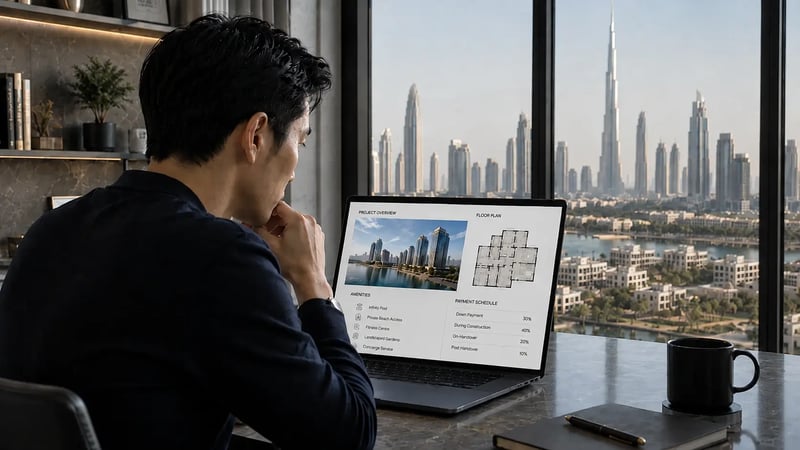

Many Chinese buyers evaluate Dubai developments remotely, in Mandarin, and through a mix of Xiaohongshu, WeChat, and Chinese-speaking agent networks. Direct contact with a developer may happen only after buyers have compared several projects. A weak Chinese-language presence can therefore reduce the chance of entering the buyer's shortlist in the first place.
Chinese buyers remain a meaningful part of Dubai's international residential market. Anarock report, cited by Khaleej Times, ranks Chinese investors among Dubai's three largest residential buyer groups, accounting for 14% of buyers in its nationality breakdown. The exact share will move with the market, but the underlying point is clear: Chinese demand is significant enough that developers need to be visible and credible inside the channels these buyers use to research property.
Where Do Chinese Buyers Discover Dubai Developments?
Mainland Chinese buyers commonly use Xiaohongshu, Douyin, WeChat, and Chinese-speaking agents in Dubai. English-language channels such as Google, Property Finder, and Instagram can still play a role, but they are less useful when the buyer's research and referrals are happening inside Chinese-language ecosystems.
On Xiaohongshu (Little Red Book), users post detailed comparison notes on international property markets: floor plans, payment schedule breakdowns, community reviews, and agent recommendations. Jing Daily reported that Xiaohongshu was approaching 600 million daily searches in Q4 2024, roughly half Baidu's volume at the time. That makes it useful to think of the platform as a search-and-discovery layer, not only a social feed. Douyin adds video walkthroughs and commentary, while WeChat supports private conversations, referrals, and group-based sharing.
Dubai's established Chinese community can act as an informal information network for buyers researching from abroad. A Xiaohongshu post comparing two Dubai Marina developments can be saved, shared, and discussed by prospective investors before they speak to a developer. That kind of peer content can influence the shortlist in ways an English-language campaign cannot easily replicate. If a development has little credible Chinese-language information around it, buyers are left with an information gap that can feel like additional risk.
Many developers still have no systematic relationship with this network. We covered the platform landscape in more detail in our guide to the top B2B digital Chinese marketing platforms for businesses in the UAE.
What Criteria Do Chinese Buyers Use to Compare Developments?
Six factors recur in cross-border buyer evaluation, and standard developer collateral often answers them unevenly. Lifestyle matters, but so do the numbers.
- Off-plan vs. ready: Off-plan can offer payment flexibility, but it also introduces delivery and construction risk. Ready units reduce that uncertainty but usually require more capital upfront, which can matter for cross-border buyers managing funding and transfer constraints.
- Developer track record: Buyers want actual delivery history. Were previous projects handed over on schedule? What do buyers who already purchased say about the handover and after-sales experience? Developer claims are often cross-checked through agents, owners, and community channels.
- Area fundamentals: Yield with neighbourhood-level specificity, resale liquidity, tenant demand, and who else lives there. An area with an established Chinese resident or expatriate community can carry an additional social-proof advantage. A headline 6 to 9% yield range is difficult to evaluate without area-level assumptions.
- Total cost of acquisition: DLD's sale registration fee is 4% of the purchase price, with the allocation between buyer and seller determined by the sale agreement, alongside other applicable registration costs. Buyers also need visibility on agent commission, service charges, financing costs where relevant, and ongoing management expenses. A headline unit price is not enough to compare the real cost of ownership.
- Golden Visa eligibility: According to the Dubai Land Department, a real estate investor who owns property with a purchase value of AED 2 million or more can apply for a renewable 10-year residence permit. The investor can also sponsor a spouse, children, and parents. For mortgaged property, DLD requires a bank letter showing that AED 2 million has been paid. This threshold can materially influence budget and unit selection for buyers considering UAE residency.
- Remote management: Many cross-border buyers are not relocating immediately. They need to know whether the property can be rented, maintained, and managed without their physical presence. Clear property-management arrangements and Chinese-language support reduce operational uncertainty.
A beautiful render with a QR code to an English registration form answers zero of these six questions.
How Do Chinese Buyers Verify a Dubai Developer From 6,000 Kilometres Away?
Through a combination of peer social proof, agent reputation, and institutional signals such as RERA project registration and DLD escrow compliance. For buyers researching remotely, these signals help compensate for what they cannot verify in person.
Dubai's escrow framework requires off-plan purchasers to deposit payments into a project escrow account. According to the Dubai Land Department, disbursement terms are tied to major construction stages, with the account trustee verifying completion before releasing eligible payments. For a remote buyer, that provides an important institutional trust signal. But it does not replace due diligence on the developer itself. A clear record of completed projects, handover dates, construction progress, and owner experience gives buyers something more concrete to verify.
One important verification layer is Xiaohongshu. A buyer can search the development name or district and look for posts from owners, agents, and other users. Xiaohongshu's current community rules emphasise authentic, original content, and the platform actively governs improper commercial behaviour. That makes obviously manufactured advocacy a weak long-term strategy. The more durable route is to give Chinese buyers a good enough purchase and handover experience that credible third-party discussion develops naturally.
What Hidden Constraints Shape How Chinese Buyers Purchase Dubai Property?
For mainland Chinese buyers, two issues can materially shape a cross-border property purchase: China's foreign-exchange and capital-account rules, and the fact that major property decisions may involve several family members. Developer teams need to understand both without overgeneralising either.
Foreign-exchange and capital controls. China's rules are more nuanced than a simple USD 50,000 overseas-transfer cap. According to the State Administration of Foreign Exchange (SAFE), USD 50,000 is an annual foreign-exchange convenience quota, and foreign currency purchased under that quota may not be used for overseas property purchases, which fall under capital-account restrictions. Developers should therefore avoid advising buyers to pool relatives' quotas or use other workarounds. The practical marketing requirement is simpler: publish clear payment schedules and funding timelines, and direct buyers to qualified legal and banking advisers on how a purchase can be funded lawfully based on their residency, banking arrangements, and source of funds.
Family-based decision-making. A major property purchase may involve a spouse, parents, or other family members, particularly when capital, residency, education, or relocation plans overlap. The practical implication is that information should be easy to forward in Chinese and understandable to someone who has never visited Dubai. Recent stress in China's domestic property sector has also made delivery risk and developer credibility familiar concerns. Materials available only in English, or only after a sales-centre visit, are harder to use in that wider decision process.
Timezone and language also shape follow-up. China is four hours ahead of Dubai, so a lead handled late in the Dubai working day may already be outside normal China business hours. A Mandarin response path and clear ownership of China-time enquiries reduce avoidable delay. This is the same speed-to-response problem that costs developers deals across every buyer nationality, compounded by language and timezone.
How Should Dubai Developers Adapt Their Marketing for Chinese Buyers?
By being present inside the ecosystem where evaluation often happens: Chinese-language content on Chinese platforms, WeChat as a live contact channel, Mandarin follow-up during China business hours, and a CRM structured to capture buyer intent from the first touchpoint. A translated brochure alone is not enough. Translation without distribution solves the language problem but not the discovery, trust, or follow-up problem.
- Chinese-language content on Chinese platforms: Xiaohongshu posts that directly address the six evaluation criteria. Douyin video walkthroughs can show the unit, view, building, and neighbourhood in a format buyers can assess remotely. Native or properly localised Mandarin is more useful than simply translating an English campaign asset.
- WeChat as a live contact channel: A WeChat contact staffed during China hours can create a lower-friction entry point than an English registration form. WeCom (WeChat Work) also gives businesses more control over contact ownership, conversation visibility, and CRM integration than relying only on individual salespeople's personal accounts.
- CTAs sized to the distance: "Book a 15-minute video call" or "Download the full cost breakdown in Chinese" are better aligned with a remote buyer than making a sales-centre visit the primary next step.
- Mandarin follow-up during China hours: Respond promptly in Mandarin while the buyer is still active, and route China-origin enquiries to a team that can cover the relevant hours. The useful benchmark is not an arbitrary response-time claim; it is whether the buyer can continue the conversation without waiting for the next Dubai working day.
- CRM fields that capture intent: Golden Visa, rental yield, education, eventual relocation. These motivations call for different follow-up. A CRM that captures only name, email, and phone limits how well the sales team can segment and respond. Capture WeChat ID and stated motivation from the first contact where appropriate.
Oxygen's own China-market campaigns show why channel design matters. For one of our client projects, DMCC, WeCom received 450+ new WeChat "friend requests", while Parllay converted 48.7% of new WeChat followers into potential customers through an automated lead nurturing workflow. On a separate Xiaohongshu project, registrations from Xiaohongshu ads accounted for 29% of total event registrations, while cost per lead decreased by 37%. In both cases, Oxygen combined Chinese-platform distribution with localised content and conversion workflows.
The practical question is whether your development is legible inside the channels Chinese buyers use to research and compare it.
Many developments still leave gaps in that journey. The stronger competitor is the one that can provide Chinese-language content, a live WeChat contact, a full cost breakdown in Mandarin, and a verifiable delivery record. English-language ad spend cannot fully compensate for missing decision support once the buyer starts comparing projects.
Oxygen works with international businesses on Chinese-market digital strategy, building the infrastructure that turns invisible demand into a qualified pipeline. If your current funnel was not built for the buyer journey described above, it is worth a conversation.