
 International
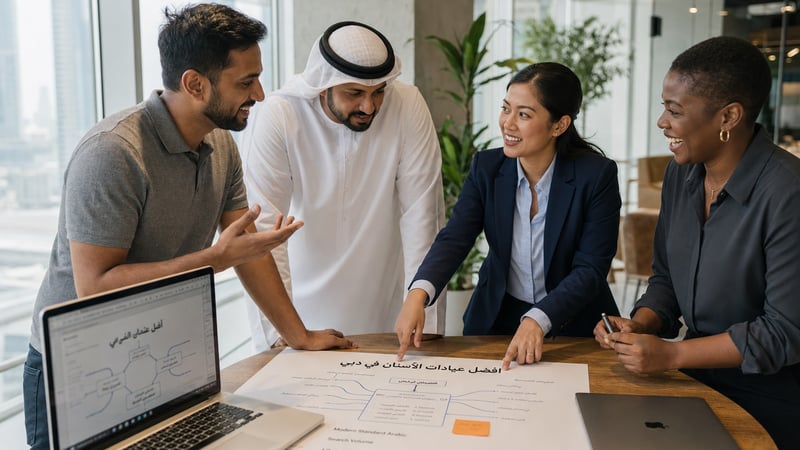

Arabic website content that needs to be found in Google and AI answers should be written in Modern Standard Arabic (MSA) rather than Gulf or Emirati dialect. For Arabic SEO, MSA is the safer, better-evidenced choice: AI models currently understand it more reliably than dialect, and it gives a page one consistent written vocabulary. No public data yet isolates its effect on ranking, so the case rests on comprehension and consistency, and it is worth measuring on your own pages.
Dialect still has a job. It builds rapport in conversations, campaigns and voice. It is a weaker foundation for pages that must be retrieved, summarised and cited, and current research suggests AI models still read dialect less accurately than MSA.
Why is MSA understood and matched more reliably?
Modern Standard Arabic is understood and matched more reliably because it is the one written form of Arabic shared across Arabic-speaking markets, and the form AI models currently understand best. Both points matter, because a page has to be matched to a query and then interpreted correctly before it can be shown or cited.
One written standard, one set of signals
MSA is widely used as the formal written register for news, government and education. Gulf dialect has no standardised spelling. The same spoken word can be written several ways, and a casual phrase such as "شو" in place of "ماذا" changes the vocabulary a page is built on.
Inconsistent spelling may scatter a page's vocabulary across variants, though no search engine has documented how it treats this. What buyers actually type also varies: some queries use formal terms, others use dialect or English, so check real query data rather than assuming either way.
One caution: Google has published no guidance saying it prefers one Arabic register over another. The case for MSA is a reasoned position about consistency and comprehension, not a documented ranking rule, and it should be presented that way internally.
AI models read MSA better today
The strongest evidence concerns AI answers. A cultural benchmark of LLMs in standard and dialectal Arabic, published at ACL 2026, tested models across 13 Arabic-speaking countries in both MSA and each country's dialect. Models performed worse on all three tasks in dialect than in MSA, across Arabic-centric and multilingual models alike.
That study measures comprehension, not web retrieval or ranking. The implication is still practical. When an answer engine has to read, summarise and cite your page, an MSA page puts the model in its strongest Arabic register.
Emirati dialect specifically is handled unevenly. DialectalArabicMMLU, built by MBZUAI, NYU Abu Dhabi and IBM Research, adapted 3,000 questions into five dialects including Emirati. Across 19 open-weight models it found substantial performance variation between dialects and persistent gaps in dialectal generalisation.
The advantage is real, but not permanent
The gap may narrow. The AraDiCE benchmark, presented in Abu Dhabi at COLING 2025, found Arabic significantly underrepresented in large language models, especially in dialects. Arabic-specific models such as Jais and AceGPT outperformed multilingual models on dialect tasks, though significant challenges persisted.
Because Arabic-specific models already do better on dialect than multilingual ones, dialect may be a weaker bet today rather than a permanently losing one. The sensible decision is MSA now, with a review as Arabic-first models mature and as AI search tools adopt them.
Write core pages in MSA first
Start with the pages that carry commercial weight: service, product, about and contact pages should be written in MSA. These are the pages buyers search for, AI tools summarise, and regulators and partners scrutinise, so they need the register that serves all three.
Draft natively, then optimise
A common weak point is the literal translation of English copy. It follows English sentence structure, borrows awkward terms and misses the phrases Arabic buyers actually search. Drafting natively in MSA avoids that, and so does resisting a dialect draft for pages meant to be found.
- Native MSA drafting: brief an Arabic writer to draft in MSA from the page's purpose and audience. A literal translation drags in English structure, while a dialect draft drags in spoken spelling, and both pull the page away from the standard.
- Terminology: fix one MSA term per service or product.
- Query research: research Arabic queries separately from English ones, including dialect words and English terms typed inside Arabic searches. Use what you find to inform the MSA page, not to rewrite it into dialect.
- Structure: keep headings, metadata and internal link text in the same MSA register as the body, so nothing on the page slips into dialect.
Keep MSA readable
MSA can feel stiff when it drifts towards classical prose. The target is contemporary MSA, the register of a well-edited Gulf newspaper, with short sentences, modern vocabulary and direct answers. That reads naturally to a Dubai buyer and still gives a model clean, standard text.
Register is only one part of a working Arabic site. Right-to-left layout, typography and domain choices shape performance too, and our guide to building an Arabic website covers those foundations.
UAE buyers make register a real trade-off
In the UAE, choosing an Arabic register is a trade-off between retrieval and rapport, because buyers switch languages, search volumes are small and sales conversations run on WhatsApp. Each of those factors pulls in a different direction.
Bilingual buyers and thin search volumes
B2B buyers in real estate, healthcare and professional services often research in English, then check Arabic content for detail, confirmation or a colleague who prefers it. Arabic pages therefore need to be found by a smaller, more deliberate audience.
Arabic search volumes in the UAE are modest for most B2B topics. When every query counts, spreading content across dialect spellings thins already limited demand further. One consistent MSA version concentrates it.
WhatsApp carries the relationship
Much of the actual selling in the UAE happens in WhatsApp threads, in whatever mix of Emirati Arabic, other dialects and English the buyer prefers. That warmth matters, and a formal website does not threaten it.
The two jobs are different. The website has to be found and trusted by people who have never spoken to the business. The conversation channel has to feel personal once they have. Splitting registers by job resolves most of the tension.
Regulated sectors expect formal Arabic
Regulation pushes core pages further towards MSA. The Dubai Land Department states that Arabic terms and conditions are mandatory because they are a government legal document, and that a RERA permit is mandatory to advertise real estate projects.
DLD does not specify MSA or ban dialect. Our reading is that property pages sitting beside formal legal and permitted content are safer in the same formal register, but that is a practical judgement, not a DLD rule.
Healthcare is less clear. No approved source here confirms that DHA or DoH require MSA, so treat formal Arabic as a practical expectation for clinical terms, treatment claims and consent language, and check the regulator's current advertising guidance directly. The visibility gap for providers is explored further in this analysis of AI search for UAE healthcare.
Where Gulf dialect still fits
Gulf or Emirati dialect works best where the goal is rapport rather than retrieval: WhatsApp flows, chatbots, voice interfaces and some short-lived campaigns. These are channels where nobody is searching an index, and sounding local is the point.
This is a practical judgement, not a rule. The research shows only that models handle dialect less reliably than MSA; it says nothing about where dialect should be used. Customers type and speak in dialect, so conversational tools must understand dialect input even when their scripted replies are more neutral. Given the uneven model performance on Emirati, test any chatbot with real dialect queries before launch.
On core pages, the added risk of dialect is credibility: informal Arabic beside formal legal or clinical content looks inconsistent in regulated sectors.
Which register should each page use?
The register should follow the job each page or channel does: MSA where content must be found and trusted, dialect where it must feel personal.
For campaign landing pages, a practical compromise is a dialect headline for rapport over an MSA body, in case the page is ever meant to rank; this is our judgement, not a tested rule.
| Page or channel | Recommended register | Why | What to check |
|---|---|---|---|
| Core service and product pages | MSA | Matches formal queries; read best by AI models | Native drafting, consistent glossary |
| Regulated-sector pages (healthcare, property) | MSA | Formal terminology alongside legal and permitted content | Current DLD, RERA, DHA or DoH requirements |
| Blog and thought leadership | Contemporary MSA | Built to rank and be cited | Readability, short sentences |
| Paid social and campaign landing pages | Dialect headline, MSA body | Headline builds rapport; MSA body keeps the option to rank | Whether the page should also rank |
| WhatsApp flows, chatbots and voice | Gulf or Emirati dialect | Not indexed; conversation needs warmth | Testing with real dialect input |
| Bilingual or English-first pages | MSA for the Arabic version | Buyers switch languages and compare versions | Matching structure and metadata in both |
Use the table to audit existing Arabic content one row at a time, starting with core and regulated pages. Any page in the first three rows written in dialect is a priority rewrite.
Default to MSA wherever being found matters
The answer is MSA for any Arabic page that needs to appear in Google or AI answers, with dialect reserved for conversations. That split keeps core pages consistent and leaves room for warmth in conversation.
The next step is measurement. No public case data yet isolates the effect of register on Arabic visibility, so track impressions for Arabic pages in Search Console and monitor whether AI tools cite them. That evidence will show when, or whether, dialect models have caught up.
Oxygen works with UAE and GCC businesses on Arabic content through its SEO and GEO services and AI search optimisation work, including deciding which pages should move from dialect to MSA. If your Arabic pages are a mix of registers and you are unsure where to start, a free 15-minute consultation is an easy way to talk it through.